Choosing Casters for Different Floors
Choosing the right tread material for your industrial casters isn’t just about how much weight they can carry—it’s about how they interact with your facility’s unique flooring. Whether you are navigating the jagged terrain of a gravel yard, the pristine surface of a coated warehouse floor, or a cracked concrete loading dock, the wheel material you choose directly impacts operator safety, equipment longevity, and floor maintenance costs.
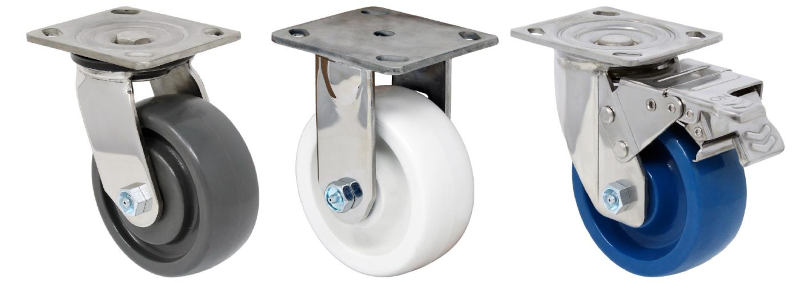
At Heavy Duty Casters, we specialize in helping you navigate these technical choices to find the perfect fit for your application.
1. Rolling on Gravel: The Need for Cushioning
Gravel and loose outdoor terrain are the “caster killers” of the industrial world. On these surfaces, a hard wheel will simply sink or get stuck against small rocks, requiring immense force to move.
- The Challenge: High rolling resistance, debris interference, and lack of traction.
- The Best Tread: Pneumatic or Semi-Pneumatic Rubber. These wheels are air or foam-filled, allowing the tread to deform slightly and “crawl” over rocks rather than pushing against them.
- The Advantage: Superior shock absorption. This protects the load from jarring movements and prevents the caster from getting lodged in loose gravel.
2. Smooth Coated Concrete: Precision and Protection
Epoxy-coated or polished concrete floors are expensive investments. Using the wrong wheel here can lead to permanent scuffing, “ghosting” marks, or even peeling of the protective coating.
-
- The Challenge: Preventing floor damage while maintaining low rolling resistance for heavy loads.
- The Best Tread: Polyurethane (PU). Polyurethane is the “gold standard” for indoor industrial use. It is hard enough to roll easily but resilient enough to protect the floor’s finish.
- The Advantage: Non-marking and quiet. High-quality PU wheels from Heavy Duty Casters won’t leave black streaks and provide a silent, smooth glide that reduces workplace noise.
3. Rough Concrete with Cracks: Durability Meets Resilience
Old warehouses often have “expansion joints,” cracks, or pitted concrete. A hard wheel (like cast iron) hitting a crack at high speed can damage the floor even further or shatter the wheel’s bearings.
- The Challenge: Impact resistance and vibration dampening.
- The Best Tread: Elastic Rubber or Thick-Tread Polyurethane. For these environments, you want a material with high “rebound,” so thermoplastic rubber casters are ideal.
- The Advantage: These materials absorb the energy when the wheel hits a crack or a bump. This prevents the “clatter” of the cart and keeps the load stable as it transitions across imperfections.
Comparison Table: Choosing Your Caster
| Surface Type | Recommended Material | Key Benefit |
| Gravel / Dirt | Pneumatic / Semi-Pneumatic | Floats over debris; high shock absorption. |
| Smooth Coated Concrete | Polyurethane (PU) | Protects floor finish; low rolling resistance. |
| Rough / Cracked Concrete | Elastic Rubber / High-Rebound PU | Dampens vibration; resists impact damage. |